
EU India Trade Deal 2026 Explained :- On 27 January 2026, India and the European Union concluded nearly 20 years of negotiations on a historic Free Trade Agreement (FTA) — widely dubbed the “mother of all deals”. Leaders celebrated the agreement as transformative for global trade, covering nearly 25 % of global GDP and about 2 billion consumers.
Table of Contents
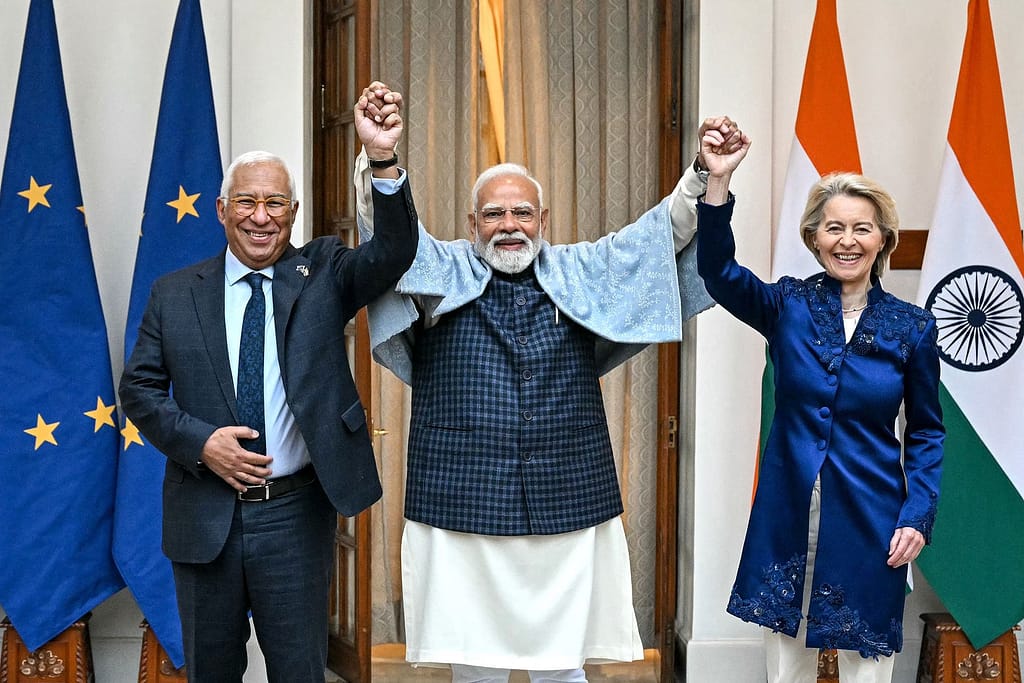
EU India Trade Deal 2026 Explained :- What Was Achieved Today
- Negotiations wrapped up at the India–EU Summit in New Delhi, signalling consensus on major elements of the trade pact after nearly two decades.
- The deal will cut or eliminate tariffs on most goods: India will slash duties on many EU imports (e.g., cars) while the EU will grant preferential access to Indian exports such as textiles, leather, marine products, chemicals, and gems.
- Tariffs on goods valued at roughly 96–99 % of bilateral trade will be removed or reduced over time.
- Sector provisions include services liberalisation, investment clauses, mobility and professional movement frameworks, broadening economic cooperation.
- Some sensitive products (e.g., certain agricultural goods) remain excluded or protected due to domestic concerns.
Implementation Deadlines & Next Steps
- The legal text must now be scrubbed and vetted, a procedural review expected to take ~5 to 6 months.
- Following legal reviews, the agreement must be signed, after which it requires ratification by the European Parliament, EU Member States, and India’s legislature.
- Formal entry into force is projected by late 2026 or early 2027, depending on legislative timelines and internal approvals.
- Tariff reductions will be phased in over several years; for example, duties on many EU car imports will be gradually reduced over a 5–7 year timeframe.
Before diving deeper into how global trade shifts affect economies and markets, it’s important to understand how such changes reflect at an individual level. Trade agreements ultimately influence inflation, income growth, and long-term financial stability.
To see how these macro developments align with your personal finances, you can calculate your own numbers using our free tools. Enter your income, expenses, and savings goals to instantly get a personalized monthly plan.
👉 Free Budget Calculator:
🔗 https://myexpenseplanner.in/
🔗 https://myexpenseplanner.in/blog/financial-calculators/
Key Decisions Still Pending
- Final ratification timings across the EU’s 27 member states and by the European Parliament remain uncertain and could delay enforcement.
- Exact phase-in schedules for tariff cuts — especially in automobiles, alcoholic beverages, and services — still require detailed implementation frameworks.
- Regulatory alignment on technical standards, data flow rules, and professional mobility remains under detailed negotiation and will be part of implementation discussions.
- Carbon and environmental clauses, including the EU’s carbon border adjustment mechanism (CBAM), are agreed in principle to continue, but technical co-ordination and support programmes are still being worked out.
Strategic and Economic Impact
For India
- Boosted export access: Indian exporters in textiles, leather, chemicals, and marine products will gain preferential access to the vast EU market, helping reduce dependence on traditional destinations like the U.S. and China.
- Services and mobility: More liberalised access for Indian IT, professional, and business service providers could expand trade in high-value sectors.
- Investment flows from European firms are likely to increase, from manufacturing to infrastructure and tech sectors.
For the European Union
- Auto and industrial access: European firms will benefit from reduced tariffs on machinery, automobiles, pharmaceuticals, and premium goods, making them more competitive in India.
- Trade diversification: The FTA enlarges Europe’s strategic options outside U.S. influence and counterbalances trade tensions with other global partners.
- Green transition funding: The EU pledged €500 million in aid to support India’s emission reduction efforts, aligning trade and climate goals.
Wider Global Implications
The FTA is one of the largest trade agreements of the decade, reshaping global supply-chain alliances. It could accelerate shifts in comparative advantage — particularly in manufacturing, automotive production, and services — while deepening geopolitical cooperation amid rising trade protectionism elsewhere.
Sector-Wise Impact and Implementation Challenges
While the EU–India Trade Deal 2026 promises long-term economic gains, its real impact will depend on sector-specific execution and regulatory coordination. Both sides have strategically protected sensitive industries while opening high-growth areas, making implementation as important as the agreement itself.
Manufacturing and Industrial Goods
European manufacturers are expected to be among the biggest beneficiaries. Gradual tariff reductions on automobiles, engineering goods, industrial machinery, and pharmaceuticals will make EU products more competitive in India’s fast-growing consumer and infrastructure markets. However, India has negotiated long phase-in periods—especially for cars and auto components—to protect domestic manufacturers. This suggests the benefits for EU firms will materialize steadily rather than immediately.
For India, access to advanced European manufacturing inputs could improve supply-chain efficiency, encourage technology transfer, and support the government’s “Make in India” initiative. Over time, this may help Indian firms move up the value chain.
Textiles, Apparel, and MSMEs
Indian exporters in textiles, garments, leather, gems, and marine products stand to gain significantly from reduced or zero tariffs in the EU. These sectors are labor-intensive and employ millions, making the deal socially impactful as well as economically beneficial.
However, compliance with EU sustainability, labor, and quality standards remains a challenge—especially for small and medium enterprises (MSMEs). Without targeted government support, capacity building, and easier certification processes, smaller exporters may struggle to fully leverage the agreement.
Services, IT, and Skilled Mobility
A critical but less visible part of the deal is the expansion of services trade and professional mobility. Indian IT, consulting, engineering, and business service providers could benefit from improved market access and recognition of qualifications. This could strengthen India’s position as a global services hub.
That said, immigration rules, visa quotas, and recognition frameworks vary across EU member states. Until these are harmonized or clarified through implementation guidelines, the mobility benefits may remain uneven.
Sustainability and Carbon Regulations
One of the most debated aspects is the EU’s Carbon Border Adjustment Mechanism (CBAM), which remains intact under the deal. While the EU has committed financial and technical assistance to help India adapt, exporters in steel, cement, aluminum, and chemicals may face higher compliance costs in the short term.
In the long run, alignment with EU green standards could improve India’s export competitiveness globally. Still, this transition will require investment, policy coordination, and predictable regulatory timelines.
Geopolitical and Strategic Implications
Beyond economics, the deal strengthens strategic ties between India and the EU at a time of rising global trade fragmentation. It reduces reliance on single markets, diversifies supply chains, and positions both partners as advocates of rules-based trade.
For India, the agreement signals openness and reform credibility. For the EU, it deepens engagement with a fast-growing economy outside traditional Western alliances. This strategic dimension could lead to future cooperation in technology, defense manufacturing, and digital trade.
Key Implementation Risks
Despite its promise, risks remain. Delays in ratification, domestic political resistance, regulatory complexity, and uneven enforcement could slow benefits. Clear timelines, transparent communication, and active industry consultation will be essential to convert the agreement into measurable economic gains.
Summary
The EU–India “mother of all deals” marks a historic trade pact with deep tariff cuts, services liberalisation, and broader economic cooperation. Though negotiations have concluded, legal scrubbing, ratification, and phased implementation will span most of 2026–2027. Its strategic impact will be felt across goods and services trade, investment flows, and global economic diversification.
Leave a Reply