
Nivi | Blog
How Much Student Loan Debt Is “Normal” in the USA? The 2026 Numbers Might Surprise You :-
If you’re staring at a student loan balance and wondering whether you’re behind, ahead, or right where everyone else is — you’re not alone, and the honest answer is more reassuring than most headlines make it sound.
Here’s the number that gets quoted everywhere: the average American student loan borrower owes around $43,500. But that number is misleading, and once you see why, the picture of what’s actually “normal” changes a lot.
The Real Number: Average vs. Median (They’re Not the Same)
- Average student loan balance (federal + private): ~$43,500
- Median student loan balance: ~$24,100
That’s nearly a $19,000 gap between the two — and it exists because a relatively small group of graduate, law, and medical school borrowers carry six-figure balances that pull the average way up. The median — the number where half of borrowers owe more and half owe less — is a far more realistic picture of what a “normal” borrower actually owes.
In plain terms: if you graduated with $24,000–$30,000 in student debt, you are firmly in the middle of the pack, not behind.
What’s “Normal” by Degree Type
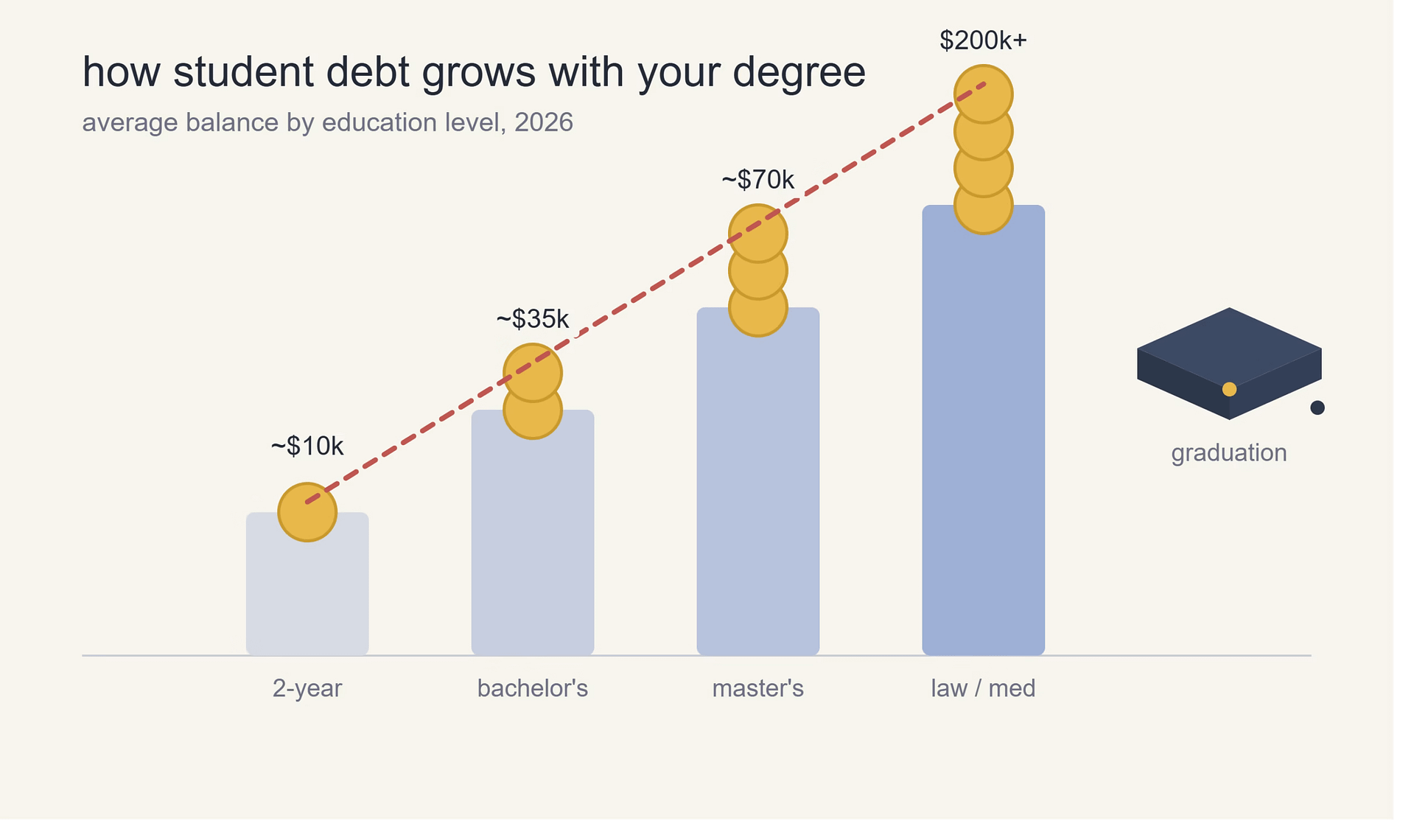
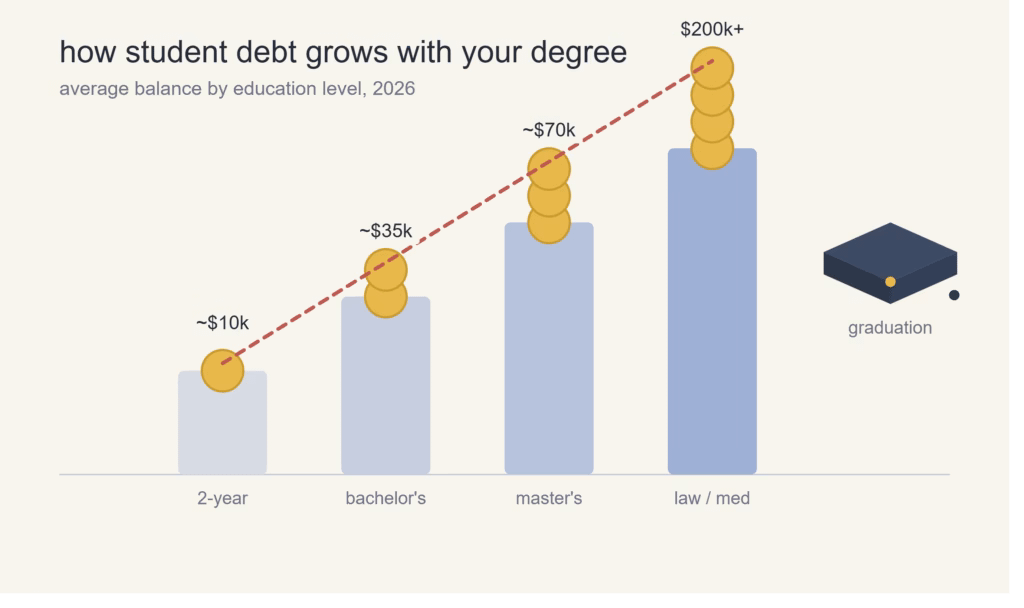
Debt levels vary enormously depending on what you studied and how far you went. Here’s the general 2026 breakdown:
| Degree / Path | Typical Total Debt |
|---|---|
| Community college | ~$10,000 |
| Bachelor’s degree (public university) | ~$30,000–$38,000 |
| Bachelor’s degree (private university) | Often $45,000+ |
| Master’s degree (added on top of undergrad debt) | ~$70,000 total |
| Law school | $130,000–$180,000+ |
| Medical school | $200,000+ |
The gap between a bachelor’s degree borrower and a law or medical school borrower is enormous — which is exactly why national “averages” don’t mean much for any one person. Compare yourself to your degree path, not the national average.
The National Picture (For Context)
To understand where individual debt fits into the bigger picture:
- Total U.S. student loan debt (federal + private combined) has climbed to roughly $1.86 trillion
- That debt is held by more than 42 million borrowers
- Federal loans make up about 91% of all student debt; private loans make up the rest
- Nearly half of Class of 2024 bachelor’s graduates left school without any student loan debt at all — meaning “normal” also includes zero
That last point matters: a large share of graduates carry no student debt at all, usually due to scholarships, family support, or working through school — so “normal” isn’t a single number, it’s a wide range.
The One Rule of Thumb Worth Remembering
Financial advisors commonly use one simple benchmark to judge whether student debt is manageable:
Your total student loan debt shouldn’t exceed your expected first-year salary after graduation.
Under this guideline:
- A nursing graduate expecting a $65,000 starting salary can reasonably carry up to ~$65,000 in debt
- A social work graduate expecting a $42,000 starting salary should aim to keep debt well under that number
- A borrower with $180,000 in law school debt needs a correspondingly high starting salary for that debt to stay “normal” in a practical sense
This is a far more useful test than comparing yourself to a national average, because it ties your debt to your actual ability to repay it.
Why Debt Levels Vary So Much by State
Where you go to school changes your debt load significantly, mainly because of two factors:
- In-state vs. out-of-state tuition — states with a higher share of students attending private or out-of-state schools tend to show higher average per-borrower debt
- Cost of living during school — housing-expensive states push total borrowing up even when tuition itself is similar
If you’re choosing between schools, the in-state vs. out-of-state tuition gap is often a bigger lever on your future debt than the sticker price of tuition alone.
So — Are You “Behind” or “Normal”?
Use this quick gut-check:
- Under $30,000, bachelor’s degree: Right around the median — normal
- $30,000–$45,000, bachelor’s degree: Above median but common, especially at private or out-of-state schools
- Under your expected first-year salary, any degree: Manageable by the standard financial guideline
- Well above your expected first-year salary: Worth a serious repayment plan conversation — not a crisis, but worth addressing early rather than later
The goal isn’t to hit a specific number — it’s to know how your number relates to your actual repayment ability, which the national headlines never tell you.
What to Do Next
If you’re still in school or about to graduate, the earlier you map out a real repayment plan against your expected income, the fewer surprises you’ll have later. Our college student monthly budget guide and free budgeting calculator can help you build that picture before your first loan payment is due.
Frequently Asked Questions
What is considered a “normal” amount of student loan debt in 2026? The median U.S. borrower owes around $24,000. The widely-quoted “average” of roughly $43,500 is skewed upward by graduate, law, and medical school borrowers with much larger balances — so the median is a more realistic benchmark for a typical bachelor’s degree borrower.
Is $30,000 in student loans a lot? No — $30,000 is close to the typical range for a bachelor’s degree from a public university and is considered manageable under the standard “debt shouldn’t exceed first-year salary” guideline for most career paths.
Why is the average student loan debt so much higher than the median? Because a relatively small number of borrowers — mainly those with graduate, law, or medical degrees — carry balances of $100,000 to $200,000+, which pulls the mathematical average far above what most borrowers actually owe.
Does everyone graduate with student debt? No. Roughly half of recent bachelor’s degree graduates finish school with no federal or private student loan debt at all, usually through scholarships, grants, family support, or working through school.
Sources
This article references data from Federal Student Aid, the Federal Reserve (G.19 release), the Federal Reserve Bank of New York Household Debt and Credit report, and LendingTree/Education Data Initiative research, as published in 2026. Figures are updated quarterly by these sources — always confirm current numbers on official government sources (studentaid.gov, federalreserve.gov) before making borrowing decisions.
MyExpensePlanner content is for educational purposes and does not constitute personalized financial advice. Consult a licensed financial advisor for advice specific to your situation.
Leave a Reply