
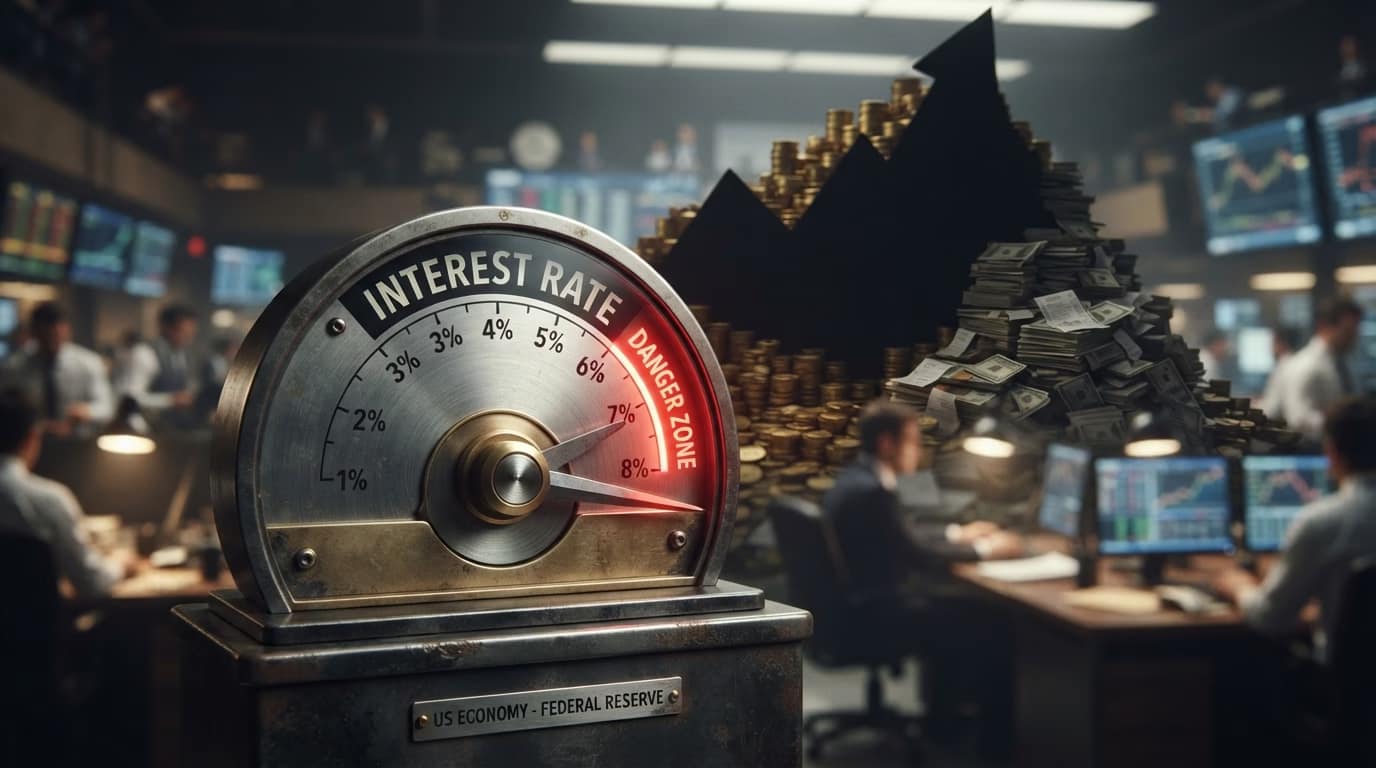
For decades, investors lived in a world where low interest rates seemed almost permanent. Mortgages became cheaper, stock valuations expanded, and government borrowing surged. But as America’s debt burden continues to climb, a critical question is emerging: Are higher interest rates here to stay?
America’s Debt Crisis Is Growing :- For U.S. investors, the answer could determine everything from stock market returns and housing affordability to retirement planning and portfolio strategy.
Table of Contents
A New Economic Era Is Beginning
The United States has entered a period unlike anything seen since the 1980s. Federal debt has surged to record levels, inflation remains a concern despite cooling from its peak, and government spending needs continue to increase.
For nearly fifteen years after the Global Financial Crisis, investors enjoyed extraordinarily low interest rates. The Federal Reserve kept borrowing costs near zero, helping fuel one of the greatest bull markets in history.
That environment may be ending.
Higher interest rates are no longer simply a temporary response to inflation. Increasingly, economists and bond investors are beginning to ask whether structural factors—particularly America’s massive debt load—could keep rates elevated for years.
Understanding America’s Debt Problem
The U.S. government currently owes tens of trillions of dollars, and the debt continues to rise every year due to:
- Persistent budget deficits
- Rising entitlement spending
- Increased defense expenditures
- Growing interest payments on existing debt
- Aging demographics
The challenge is not merely the size of the debt itself.
The real concern is the cost of servicing that debt.
When interest rates rise, the government must pay significantly more to refinance maturing Treasury bonds and issue new debt.
In simple terms:
Higher debt + Higher rates = Exploding interest expenses
Interest payments are becoming one of the largest items in the federal budget.
Why This Matters to Investors
Government borrowing affects virtually every financial asset.
Treasury yields serve as the foundation for pricing:
- Mortgage rates
- Corporate borrowing costs
- Auto loans
- Credit cards
- Stock valuations
- Commercial real estate financing
When Treasury yields remain elevated, money becomes more expensive throughout the economy.
This can fundamentally reshape investment returns for years.
The Era of “Free Money” May Be Over
Between 2009 and 2021, investors became accustomed to near-zero rates.
This environment created enormous wealth effects:
- Technology stocks surged.
- Real estate prices skyrocketed.
- Private equity flourished.
- Venture capital exploded.
Low rates effectively increased the value of future earnings, allowing investors to pay premium valuations for growth companies.
However, when rates rise, future cash flows become less valuable.
This is why many high-growth companies experienced sharp valuation declines when interest rates began increasing.
The investment landscape may now be shifting toward a more balanced regime where earnings quality matters more than simply future growth projections.
Why Debt Could Keep Rates Elevated
Historically, recessions often pushed interest rates lower.
But today’s situation is different.
Several structural forces may prevent rates from falling back to previous lows.
1. Massive Treasury Issuance
The government must continuously issue large quantities of debt.
Increasing supply often requires higher yields to attract buyers.
2. Declining Foreign Demand
Countries such as China and Japan have slowed purchases of U.S. Treasuries compared to previous decades.
If foreign demand weakens, domestic investors may require higher yields.
3. Persistent Fiscal Deficits
Government spending continues to exceed revenues by substantial margins.
As deficits remain elevated, borrowing needs continue increasing.
4. Inflation Risks
Even if inflation moderates, investors may demand higher yields as compensation against future inflation uncertainty.
The Bond Market Is Sending a Message
Bond investors are often called the “smart money” because they focus heavily on economic fundamentals.
The bond market increasingly appears concerned about long-term fiscal sustainability.
Higher long-term Treasury yields suggest investors may be demanding greater compensation for lending money to the government.
This does not imply an immediate crisis.
However, it signals that markets may no longer assume that ultra-low rates will return quickly.
How Higher Rates Could Affect Every American Household
Housing Affordability May Remain Challenging
Mortgage rates are heavily influenced by Treasury yields.
Even if the Federal Reserve eventually cuts short-term rates, mortgage rates may not decline dramatically if long-term yields remain elevated.
This could mean:
- Higher monthly payments
- Lower housing affordability
- Slower home price appreciation
- Increased pressure on first-time buyers
For many households, housing costs may remain significantly higher than during the 2010s.
Credit Card and Consumer Debt Costs Could Stay High
Americans carry substantial amounts of consumer debt.
Higher interest rates increase borrowing costs on:
- Credit cards
- Personal loans
- Auto financing
- Home equity loans
Households may increasingly prioritize debt reduction rather than discretionary spending.
This could affect consumer-driven sectors of the economy.
Retirement Planning Becomes More Difficult
For years, retirees struggled because bonds generated little income.
Higher rates create opportunities for fixed-income investors.
However, they also introduce new challenges:
- Lower stock market valuations
- Potential economic slowdowns
- Increased market volatility
Retirement planning may increasingly require a balanced approach between growth and income assets.
What Higher Rates Mean for the Stock Market
The implications vary significantly across sectors.
Potential Winners
Financial Institutions
Banks can benefit from higher rates through improved lending margins, provided economic conditions remain stable.
Insurance Companies
Insurers invest heavily in bonds.
Higher yields can significantly improve long-term profitability.
Dividend Stocks
Companies with strong cash flows and reasonable valuations may become increasingly attractive.
Value Stocks
Businesses generating earnings today may outperform speculative companies dependent on future growth assumptions.
Potential Losers
Highly Leveraged Companies
Businesses carrying substantial debt may face rising financing costs.
Unprofitable Growth Firms
Companies depending on cheap capital could encounter increasing pressure.
Commercial Real Estate
Higher borrowing costs can reduce property values and refinancing opportunities.
Speculative Assets
Assets benefiting from abundant liquidity may struggle in a prolonged high-rate environment.
Could Higher Rates Trigger a Debt Spiral?
One concern frequently discussed by economists is the possibility of a debt-interest spiral.
The cycle works like this:
- Government debt rises.
- Interest expenses increase.
- Larger deficits emerge.
- More debt issuance becomes necessary.
- Investors demand higher yields.
- Interest costs rise further.
This scenario is not inevitable.
The United States still possesses enormous economic strengths:
- World’s largest economy
- Global reserve currency
- Deep and liquid financial markets
- Strong institutional framework
However, ignoring fiscal sustainability indefinitely could create increasing challenges.
Is America Heading Toward a Fiscal Crisis?
Most economists do not foresee an immediate sovereign debt crisis.
The U.S. government retains exceptional borrowing capacity.
Nevertheless, investors should recognize that long-term fiscal pressures can gradually influence economic performance.
Instead of a sudden crisis, the greater risk may be:
- Slower economic growth
- Persistently higher inflation risks
- Elevated interest rates
- Increased market volatility
This slower-moving adjustment could still significantly impact household wealth.
The Federal Reserve’s Difficult Balancing Act
The Federal Reserve now faces competing objectives.
It must:
- Control inflation
- Support employment
- Maintain financial stability
- Avoid excessively restrictive conditions
At the same time, elevated government borrowing creates additional complexity.
Even if inflation declines, structural factors may prevent rates from returning to near-zero levels.
This represents a significant shift from the post-2008 investment environment.
Lessons From History
The 1970s and early 1980s provide important lessons.
During that period:
- Inflation remained persistent.
- Interest rates rose sharply.
- Bond investors suffered.
- Stock valuations compressed.
While today’s economy differs substantially, history demonstrates that financial regimes can change for extended periods.
Investors should avoid assuming that the previous decade’s conditions will automatically return.
Portfolio Implications for U.S. Investors
If higher rates become the new normal, investors may need to rethink traditional assumptions.
Consider Greater Diversification
Portfolios heavily concentrated in a small number of high-growth companies may face increased risks.
Diversification across sectors becomes increasingly important.
Focus on Balance Sheet Strength
Companies with:
- Low debt
- Strong cash flows
- Pricing power
could become more resilient.
Income Matters Again
For the first time in many years, bonds and income-generating assets may provide meaningful returns.
This could alter portfolio allocations for retirees and conservative investors.
Valuation Discipline Becomes Critical
Investors may increasingly reward businesses generating consistent earnings rather than purely speculative growth stories.
Sectors That Could Benefit in a Higher-Rate World
Several sectors could prove relatively resilient:
Financials: Higher yields may improve profitability.
Industrials: Infrastructure spending and reshoring trends could provide support.
Energy: Supply constraints may continue supporting long-term demand.
Defense: Government spending priorities remain elevated.
Healthcare: Defensive demand characteristics make the sector attractive during uncertain periods.
The Bigger Question: Is the “Low-Rate World” Gone Forever?
No one can predict interest rates with certainty.
Recessions, geopolitical shocks, or rapid disinflation could eventually push yields lower.
However, investors should seriously consider the possibility that the extraordinary conditions of the 2010s represented an exception rather than the norm.
The combination of:
- Massive government debt
- Aging demographics
- Persistent fiscal deficits
- Geopolitical fragmentation
- Supply-chain restructuring
could support a structurally higher interest-rate environment.
Key Signs Investors Should Watch
Over the coming years, several indicators may determine whether higher rates become permanent:
- Federal budget deficits.
- Treasury auction demand.
- Inflation expectations.
- Foreign purchases of U.S. debt.
- Federal Reserve policy decisions.
- Long-term Treasury yields.
- Economic growth trends.
Monitoring these indicators may provide valuable clues about the future direction of markets.
Final Thoughts
America’s debt situation does not necessarily imply an imminent crisis.
The United States remains one of the world’s strongest and most dynamic economies.
Yet investors may be entering a new financial regime.
For years, markets benefited from abundant liquidity and historically low borrowing costs. The next decade could look very different.
Higher interest rates may no longer be a temporary phenomenon but rather a structural feature of the economic landscape.
If that proves true, the implications will reach far beyond Wall Street.
They could influence:
- Home affordability
- Retirement outcomes
- Stock market returns
- Government spending priorities
- Consumer borrowing costs
- Household wealth creation
For U.S. investors, the most important takeaway may be this:
The investment playbook that worked from 2010 to 2021 may not fully work in the decade ahead.
Adapting to a world of potentially higher rates—through diversification, valuation discipline, and stronger focus on quality assets—could become one of the defining challenges and opportunities of the next generation of investing.
Related Reads :- How U.S. Trade Deals Could Reshape America’s Finances: 3 Big Economic Shifts That Will Impact Every Household
Discover smarter ways to stay ahead of economic changes at
Further Reading:
Explore retirement planning strategies, investment calculators, budgeting tools, and long-term wealth-building resources at MyExpensePlanner.in. Investors can also use the comprehensive collection of financial calculators at financial-calculators to model different economic scenarios and make informed financial decisions.
Leave a Reply