
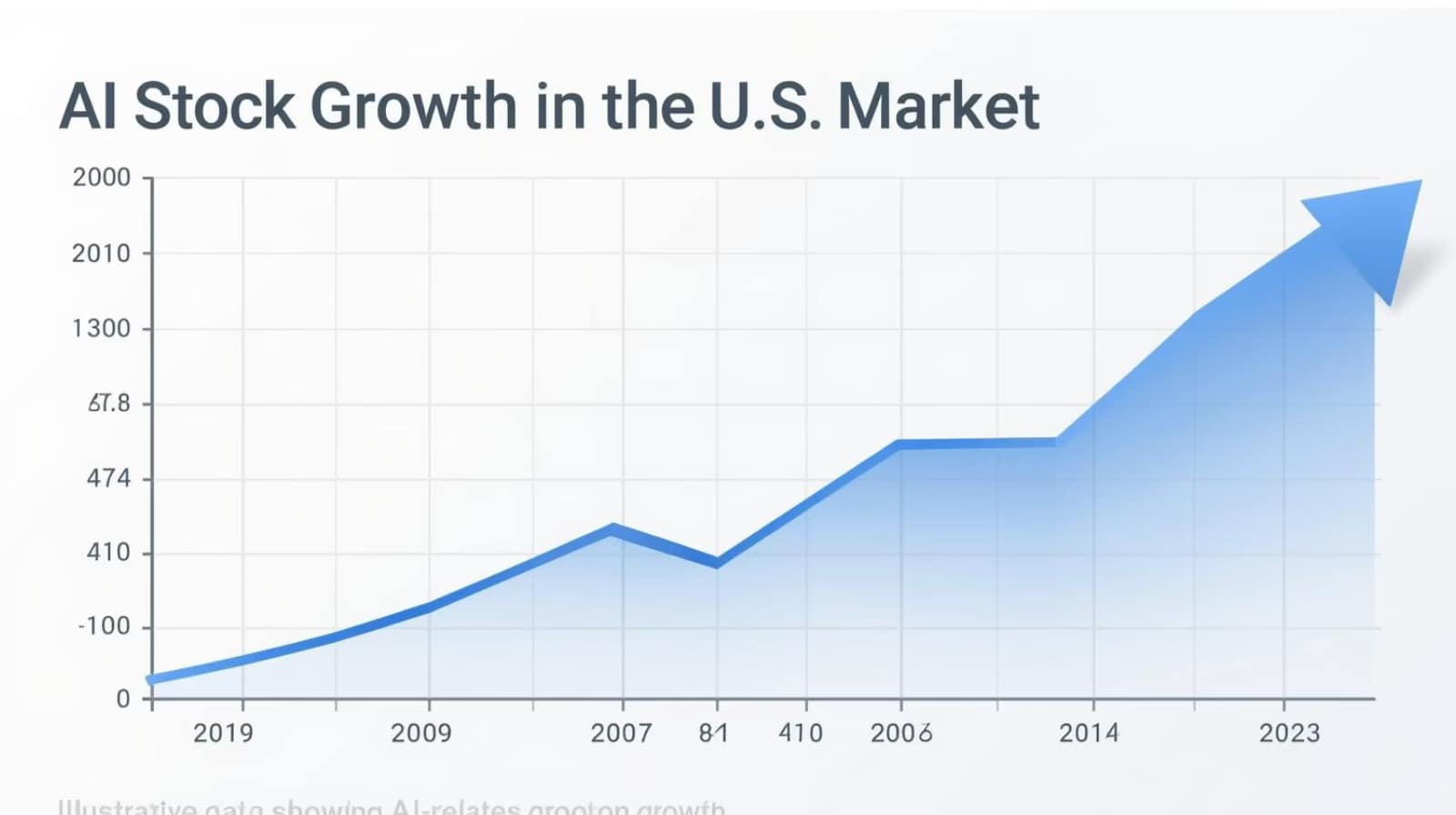
Few themes have dominated the U.S. stock market recently as much as artificial intelligence. From AI chips to cloud infrastructure to enterprise automation, investor enthusiasm has skyrocketed—pushing valuations of AI-linked companies to levels not seen since previous tech booms. But with the excitement has come a growing debate: Is this a genuine technological revolution or the early stages of an AI bubble?
Interestingly, both sides have compelling arguments. Here’s a balanced breakdown so you can decide for yourself.
Table of Contents
The Case for an AI Bubble
1. Classic Bubble Dynamics Are Showing Up
Many investors argue that AI stocks today display the same patterns seen in past speculative manias. A wave of companies has rushed to incorporate “AI” into their branding and product lines—sometimes with minimal connection to actual AI capabilities.
The sharp inflows into AI-themed ETFs, the explosive rise of chipmakers, and the doubling of valuations in a matter of months all resemble familiar bubble signals.
2. Expert Warnings Are Growing
Several prominent market observers are openly cautious:
- Bank of America’s global fund manager survey recently reported that more than half of professional investors believe AI-driven stocks are already in bubble territory.
- Pat Gelsinger, former Intel CEO, put it bluntly in an interview:
“Are we in an AI bubble? Of course. We’re hyped. We’re accelerating. We’re putting enormous leverage into the system.” - Hedge fund heavyweight Elliott Management has issued repeated warnings that companies such as Nvidia are drifting into “bubble land,” arguing that some AI models may never become cost-efficient enough to justify their valuations.
- Even major financial news outlets have noted sudden, sharp tech stock selloffs triggered by fears that the AI rally is overextended.
They point toward a simple conclusion: valuation growth is outpacing real earnings growth, and sentiment could turn quickly.
3. Comparisons to the Dot-Com Era
While AI today is more developed than early internet technologies were in 1999, the mentality is similar:
- Heavy reliance on future promises
- Retail investor FOMO
- Exaggerated expectations for immediate transformation
- High concentration of gains in a few mega-cap names
These ingredients have historically preceded steep corrections.
The Case Against an AI Bubble (or Why This Time Might Be Different)
1. Today’s AI Leaders Are Actually Profitable
Unlike the dot-com era, many of today’s largest AI players—Nvidia, Microsoft, Amazon, Google—are not speculative start-ups but highly profitable, cash-generating tech giants. They have real earnings, massive customer bases, and dominant product ecosystems.
Analysts at Goldman Sachs have stated that although AI-driven valuations are elevated, they don’t see the structural economic imbalances typically associated with bubbles—such as high leverage, collapsing savings, or widespread unprofitable business models.
2. Real AI Revenue Streams Are Emerging
From cloud AI services to enterprise automation and chip manufacturing, companies are generating measurable income from AI—not just theoretical projections.
Investopedia has also pointed out that much of the current AI investment surge is funded by companies with strong balance sheets, unlike the thinly capitalized dot-com startups of the early 2000s.
3. AI Could Spark a Long-Term Productivity Revolution
Supporters of the bull case believe AI is not hype—it’s an economic breakthrough.
AI’s potential includes:
- Automating repetitive work
- Enhancing decision-making
- Improving supply chains
- Reducing business costs
- Accelerating scientific discovery
JPMorgan CEO Jamie Dimon acknowledged that while some people will lose money chasing speculative AI trades, the underlying technology is transformative enough to reshape industries and society.
In other words: even if a short-term bubble forms, the long-term trend could still be massively bullish.
Current Reality: A Grey Zone
So, which is it—a bubble or a boom?
Right now, the answer lies somewhere in the middle.
There are clear signs of speculative excess:
- Certain stocks priced far beyond fundamentals
- Companies adding “AI” as a marketing tool
- Heavy market concentration in a handful of mega-cap names
But at the same time, there are strong arguments for a genuine structural shift:
- Real revenue from real AI products
- Corporate adoption accelerating
- Massive investment in infrastructure (chips, data centers, cloud platforms)
- Productivity potential unmatched by previous tech cycles
This is why many analysts consider the current moment a hybrid state: hype on top of a very real technological transformation.
What Investors Should Watch Next
To navigate this uncertain landscape, experts recommend monitoring:
✅ 1. Valuations vs. Earnings
Is revenue growth actually keeping up with market cap growth?
✅ 2. Market Concentration
Are only a few giants driving the entire S&P 500?
✅ 3. AI Infrastructure Spending
Are companies getting real ROI or just chasing hype?
✅ 4. Macroeconomic Conditions
Higher interest rates could hit highly valued tech stocks first.
✅ 5. Investor Sentiment
Bubbles don’t burst because of earnings—they burst because psychology shifts.
Final Thoughts
Are we living through an AI bubble?
Possibly.
Are we witnessing the beginning of a historic technological shift?
Also quite possibly.
The truth is, the market today reflects both excitement and innovation, both hype and genuine progress. Whether this becomes a burst bubble or a long-term growth story depends largely on one thing:
Can AI deliver profits at the scale investors expect?
For now, the future remains unwritten—and that’s what makes this moment so fascinating.
Plan Smarter With the Right Tools
Want to see how these IRS changes and deductions could impact your own finances? Use our free tax and savings calculators to forecast your future and make smarter money moves.
👉 Check them out here:


Leave a Reply to AI Music Generator Cancel reply